

I am an undergraduate at the University of Wisconsin-Madison, studying Statistics with certificates in Computer Science and Mathematics. I have been fortunate to work with Yang Lu, Yue Zhao, and Xiyang Hu.
My research focuses on evaluating and understanding language models, with an emphasis on interpretability, agents, and multimodal learning. I am interested in evaluations that reveal model failures and training methods that make their behavior more reliable. I am also excited about extending agentic RL to open-ended domains without verifiable answers.
I am applying to CS PhD programs for Fall 2027.
Research
-
Statistical Confidence for LLM Circuit Discovery via Randomized Interventions
Estimating the causal contributions of circuit edges with calibrated statistical tests that reuse model evaluations.
[Paper][Abstract]
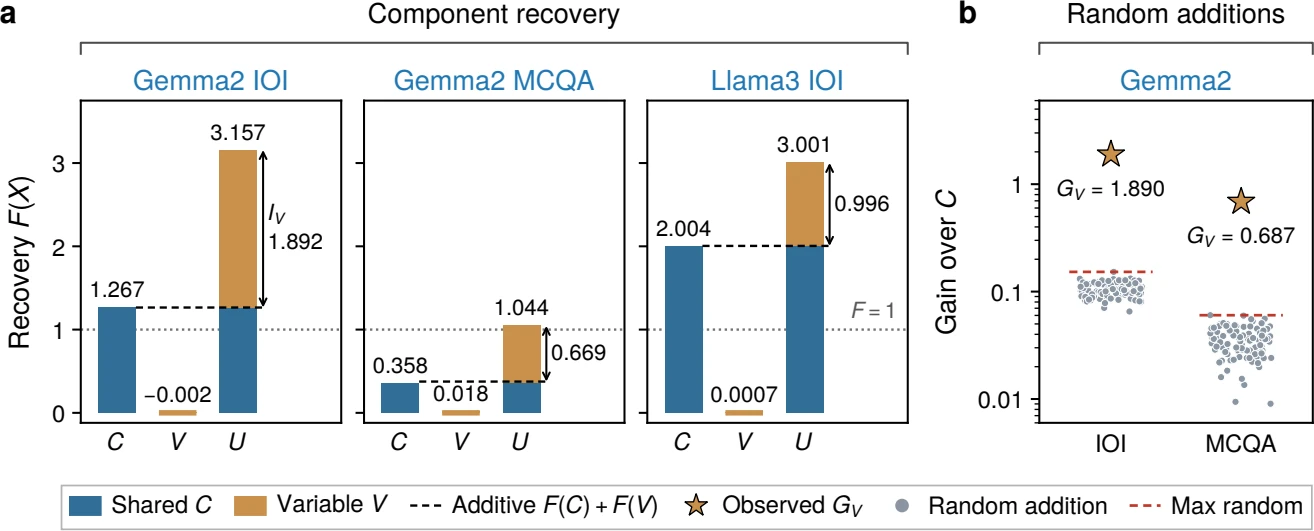
Circuit discovery maps the connections in a large language model (LLM) that produce a target behavior, offering a route to audit and debug these models. Yet an edge’s contribution depends on which other connections are present. Establishing confidence in such discoveries therefore requires statistical evidence that accounts for circuit context. We introduce a randomized-intervention framework that estimates average edge contributions across three circuit densities, from sparse to near-complete, and tests whether each edge’s average effect is nonzero at any density. We draw candidate edges from several task-preserving input transformations and randomize their inclusion to construct different circuit contexts. Our method reuses the same model evaluations to compute p-values for all candidate edges, making large-scale assessment with multiple-testing correction practical. Across five model–task settings, including one with over 34,000 candidate edges, the resulting p-values are empirically calibrated: they stay uniform or conservative on structural negative controls, with zero false discoveries after correction. In every setting, edges selected under all input transformations pass correction at higher rates than those selected under only some. Fixed-circuit analyses in two tasks reveal superadditivity: variable components contribute little alone, but combining them with shared components more than doubles recovery. In each task, this gain exceeds those of all size-matched random additions. Together, these results show that an edge’s contribution is a property of its circuit context, and that randomized interventions make calibrated assessment of these contributions practical at scale.
[BibTeX]
@misc{xu2026statistical, title = {Statistical Confidence for LLM Circuit Discovery via Randomized Interventions}, author = {Zelong Xu and Yang Lu}, year = {2026}, url = {https://drive.google.com/file/d/1X8oGWCiXoo2uhfgDhot3JOm2OSLQY58h/view}, } -
CUA-SWE: When Computer-Use Agents Meet Visual Software Engineering
* Equal contribution.
A benchmark for agents that edit code and interact with running software, with deterministic tests across web, game, mobile, and DevOps tasks.
[Paper][Website][Abstract]
Software development requires more than editing code: developers repeatedly run software, interact with its interfaces, visually inspect its behavior, and use these observations to decide what to change next and whether a change works. Existing coding agents and computer-use agents are largely studied in isolation, leaving this integrated development process underexplored. Diagnosing a runtime interaction failure requires agents to connect visual observations with the responsible code, then use the application again to verify the repair. We introduce CUA-SWE, a benchmark, environment, and evaluation pipeline for software engineering with computer use. Beyond studying how GUI feedback supports diagnosis and repair, we ask whether agents can complete software engineering tasks when required specification or operational information is available only through the running application’s visual interface. CUA-SWE spans four software engineering domains and requires agents to modify code and configuration, execute commands, interact with running software, and inspect visual feedback within the same task. Each task includes deterministic, task-specific tests that verify whether the resulting software satisfies the requirements and preserves specified behavior. Our evaluation characterizes how frontier agents combine source-level execution with application screenshots and graphical interaction to produce verified software changes. We examine performance across domains and task information requirements, alongside the development behaviors associated with successful repairs. CUA-SWE provides a unified testbed for studying how agents use visual feedback and interaction to guide software engineering, with executable correctness criteria for the resulting software.
[BibTeX]
@misc{wang2026cua, title = {CUA-SWE: When Computer-Use Agents Meet Visual Software Engineering}, author = {Prince Zizhuang Wang and Chenhao Liang and Zelong Xu and Aojie Yuan and Xiaolin Zhou and Haiyue Zhang and Yue Zhao and Xiyang Hu and Shuli Jiang}, year = {2026}, eprint = {2609.32600}, archivePrefix= {arXiv}, url = {https://arxiv.org/abs/2609.32600}, } -
SyncRA: Learning Temporal Correspondence in Omni-Modal Models
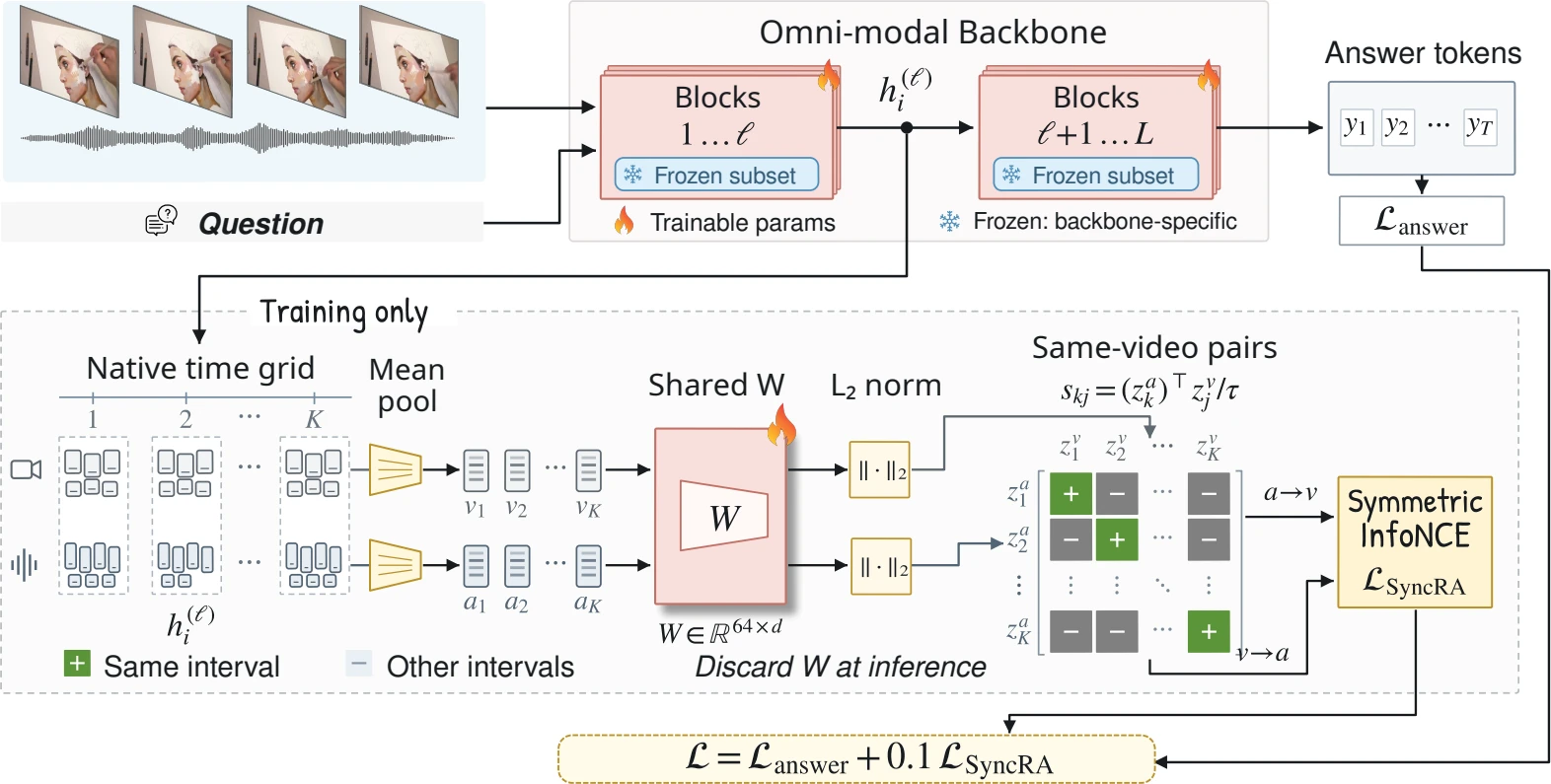
Learning audio-visual temporal correspondence from input timing alone, without extra annotations or inference-time cost.
[Paper][Abstract]
Recent omni-modal models demonstrate strong perception of audio and visual inputs, yet often struggle to connect what they hear with what they see at the same moment. This weakness in temporal correspondence can cause models to associate spoken cues with the wrong visual scenes, producing plausible answers grounded in incorrect audio-visual pairings. We diagnose this problem through controlled temporal swaps, revealing that model answers do not reliably follow changes in these pairings. To address it, we propose Synchrony-Guided Representation Alignment (SyncRA), a lightweight method for strengthening temporal correspondence between audio and vision. Specifically, SyncRA contrasts intermediate audio–visual representations within each video, aligning matching moments while separating mismatched ones to capture local temporal correspondence within a shared global context. The objective derives supervision directly from existing input timing, requiring no additional annotations and leaving inference unchanged. We evaluate SyncRA across four open omni-modal models spanning different sizes and architectures on five public video benchmarks. SyncRA consistently outperforms answer-only fine-tuning across all model–benchmark combinations, while substantially improving the ability to track changing audio–visual pairings in controlled evaluations. These results demonstrate that lightweight, targeted supervision can effectively strengthen temporal correspondence and translate into broad improvements in audio–visual question answering.
[BibTeX]
@misc{xu2026syncra, title = {SyncRA: Learning Temporal Correspondence in Omni-Modal Models}, author = {Zelong Xu and Yan Li and Wenhe Hu and Xiyang Hu}, year = {2026}, eprint = {2609.34363}, archivePrefix= {arXiv}, url = {https://arxiv.org/abs/2609.34363}, } -
DOG-DPO: Dynamic Optimization in Geometry for Safety Alignment
Selecting diverse preference directions for data-efficient safety alignment, without additional training or a teacher model.
[Paper][Abstract]
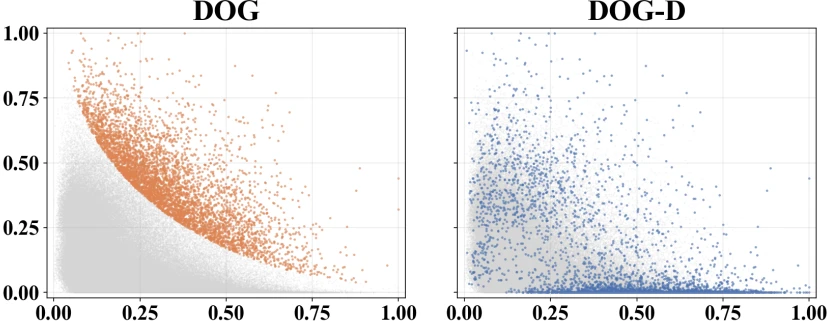
Safety alignment for large language models relies on preference data, but current pipelines often train on large, redundant datasets. Existing data selection methods typically score each preference pair independently, collapsing directional preference information into scalar quality or diversity scores. This sample-centric view is especially limiting in multi-dataset settings, where shared safety directions coexist with dataset-specific residual risks. We propose DOG-DPO, a training-free data selection framework that treats preference pairs as structured geometric signals. DOG-DPO first represents each preference pair as a direction in model representation space. It then decomposes multi-dataset preference geometry into a global anchor subspace and dataset-specific residual subspaces. Finally, it selects subsets by maximizing diversity-based coverage, encouraging broad, non-redundant coverage of alignment directions before DPO training. Across six safety benchmarks and two model backbones, DOG-DPO achieves a strong utility-robustness trade-off using only 11% of the preference pairs. It recovers most of the safety gains of full-data training while remaining entirely teacher-free, training-free, and substantially faster than representative selection baselines.
[BibTeX]
@inproceedings{nian2026dog,
  title        = {DOG-DPO: Dynamic Optimization in Geometry for Safety Alignment},
  author       = {Yi Nian and Tiankai Yang and Yudi Zhang and Qi Pan and Zelong Xu and Shenzhe Zhu and Qingqing Luan and Yue Huang and Xiangliang Zhang and Yue Zhao},
  booktitle    = {EMNLP 2026},
  year         = {2026},
  url          = {https://arxiv.org/abs/2606.07678},
}